Why the Dollar is Here to Stay

Monday, March 28, 2011

In a recent piece published in the WSJ (“Why the Dollar’s Reign Is Near an End“), Berkley Professor Barry Eichengreen declared that the Dollar will soon cease to be the world’s reserve currency. According to Dr. Eichengreen, within 10 years and for various reasons, the Dollar will become one of many reserve currencies, competing for preference with the Euro, Chinese Yuan, Japanese Yen, and Swiss Franc. While Dr. Eichengreen makes some good points, however, I don’t think most of his arguments stand up to scrutiny.


His thesis can be boiled down into a few premises. First of all, he argues that it is fundamentally illogical that oil should be priced in Dollars, and that countries conducting bilateral trade should settle their accounts using Dollars. Dr. Eichengreen is right that this represents the main underpinning of the Dollar. He is wrong to suggest that it will change anytime soon.


That’s because oil ultimately has to be priced in currency. It’s entirely possible that oil exporting countries will band together and decide to price oil in Euros, instead. However, this would mainly be useful as a political tool (albeit a very potent one!) and would serve no economic or risk management purpose whatsoever. If oil were priced in terms of a basket of currencies (such as IMF Special Drawing Rights), it might make oil prices less volatile, but then would require oil exporters to receive 5 (or more!) currencies for their oil instead of one! Finally, the price of oil can and does adjust relative to what happens in forex markets. When the Dollar declined in 2007, oil prices skyrocketed commensurately in order to compensate exporters.


The same largely applies to bilateral trade. While it makes sense for two countries with stable currencies (such as Korea and Japan, for example) to use one of their currencies as the main unit for trade, the same cannot be said for countries with more volatile currencies. For example, if Argentina and Israel are trading, one country would be inherently dissatisfied if trade were denominated either in Shekels of Pesos. When bills are settled in Dollars, however, it is easy and economical for both countries to simply convert those Dollars into currencies which may have more utility for them. As with oil, it’s possible that some countries will decide that it makes more sense to settle trade in Euros instead of Dollars, but again, I don’t see what purpose this would serve and any such decision would probably be politically motivated.


Second, Dr. Eichengreen points out that changes in technology have made it easy to instantly calculate exchange rates and easily convert currency. While I think this point is well-taken, I think people enjoy having a common base currency, if only for psychological reasons. Ultimately, this point is irrelevant because it has very little bearing on the supply and demand for particular currencies.


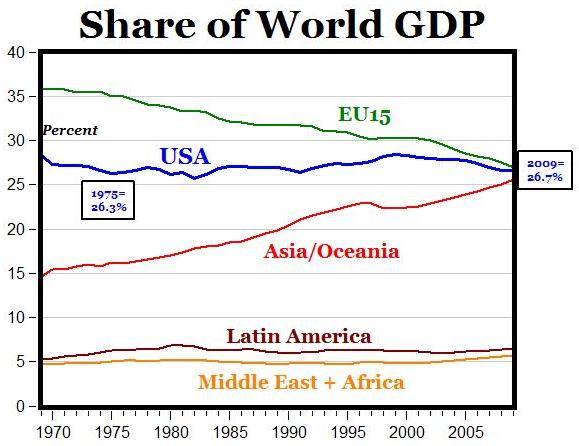
Third, he argues that the Euro and Chinese Yuan both represent latent threats to the Dollar’s preeminence. Again, he’s both right and wrong. The Euro already represents a viable alternative to the Dollar. It’s economy is reasonably strong, its monetary policy is sensible, its capital markets are deep and liquid. On the other hand, it’s being held back by perennial fears about the a Euro breakup, and the fact that the sum of 20 separate parts is not the same as the whole. Since the EU doesn’t issue sovereign debt, risk-averse investors will be limited to buying German/French/etc. bonds, which are always going to be more less liquid and more risky than US Treasury Securities. Besides, you can see from the chart below that the US economy has actually been growing faster than the Eurozone for the last 30 years.


As for China, I expounded in a recent post about how unlikely it is that the Yuan will seriously rival the Dollar anytime soon. While China certainly has plenty of cachet and expanding vehicles for investment, its capital markets remain much too primitive and opaque for Central Banks and risk-averse investors. Most importantly, the structure of China’s economy is such that foreign institutions simply don’t have the opportunity to accumulate Yuan in massive quantities. Simply, the supply is too small. In fact, the Asian Development Bank forecasts that the Yuan will constitute a mere 3-12% of international reserves by 2035. That doesn’t sound very threatening.

Dr. Eichengreen’s final point is that the Dollar’s safe haven status has been compromised. First of all, this is old news. The Yen is already a – if not the – preeminent safe haven currency, thus headlines like “Safe-Haven Yen Gains As Radiation Concern Mounts” that take irony to a whole new level. The same goes for the Swiss Franc. However, any concerns that investors have about the Dollar must necessarily also be projected onto the Yen, Euro, and Pound. All of these currencies face current or looming fiscal crises and slowing economic growth. While investors might diversify into other countries, they’re not going to suddenly dump the Dollar in favor of the Euro.


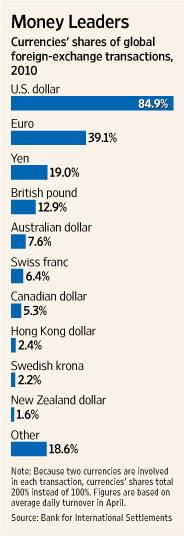
In short, it makes sense that a currency that represents 80% (out of a total of 200%) of all forex transactions and more than 60% of global reserves but only accounts for 25% of GDP, should experience a decline of some sort of decline in popularity. Over the next 50 years, the Dollar will gradually cede share to other currencies. But 10 Years? Give me a break.


SocialTwist Tell-a-Friend
READ MORE - Why the Dollar is Here to Stay

Are Entrepreneurs Born?

Jack Dorsey, founder of Twitter, discusses entrepreneurship. I enjoyed his candid responses – he truly enjoys finding and solving problems, but learned the rest of the necessary traits of an entrepreneur through the growth of his businesses.


I have a bit of a different take on entrepreneurship. I honestly think that everyone is born with entrepreneurial talent, but many of our parents, teachers, bosses, friends and even our government tend to crush entrepreneurship. Fear is the only enemy to entrepreneurship… and fear is something that we’re educated and exposed to throughout our lives.


Fear is why publishers put out formulaic books (and folks like Seth Godin are rebelling). Fear is why every other movie released is a remake of an earlier film that did well. Fear is why low-cost, terrible reality shows have permeated our television airways. Fear is why many people work in crappy jobs they’re unhappy with… they believe that success is the exception and failure is the norm. It’s not. Ask people that own their own business and you’ll find most of them wish they had done it sooner and many of them would never turn back.


Fear is debilitating – even to entrepreneurs. I know quite a few friends that have incredible imaginations, but fear prevents them from realizing their success. What’s stopping you?


You might also find these posts interesting:


Grow your business with email marketing


READ MORE - Are Entrepreneurs Born?

Writing For People Who Do Not Read

This week, I responded to a Facebook comment (ok… it was an argument) and the author immediately responded… “So we agree!”. It made me go back and reread his comment. I was embarrassed to see how terrible my comment was in response to his – I totally missed his key points.


Later on, I found a comment on my blog that blasted me… but actually didn’t differ with my opinion that I had written. It really points to a major issue on the web – people aren’t reading anymore. It’s not a matter of laziness nor is it stupidity… I really believe it’s time. Folks reach your page, glance, and come to a conclusion.


What it really points to is a need for your online messaging to be designed for maximum comprehension. Your site needs visuals – either images or video – so that readers can glance at the content, combined with the image, and fully retain the information that you’re trying to convey through the message. It’s not enough to write a 500 word post anymore.


I advise clients to do a 2 second rule on their pages. Have someone that’s never been to your site before site down and flash the site to them for 2 full seconds.


  • What did they see?

  • Was there a central message?

  • Did they retain any of the information?

  • Did they know what to do next?


It’s not that everyone doesn’t take the time – but many don’t. And those very readers could be a perfect candidate for your products or services.


You might also find these posts interesting:


Grow your business with email marketing


READ MORE - Writing For People Who Do Not Read

Forex Trading:Froex Broker reviews

A Forex broker has active role in determining the profit realization of a Forex investor. If an investor wishes for a successful business for long time then selecting the right broker is certainly the basic factor.  Forex broker reviews are very helpful in selecting a good Forex broker. The Forex broker reviews are good sources to find out the critical points one needs to consider for choosing a broker.


Mostly it is seen that one cannot find out the right image about the broker until they have traded a lot of money. Only to realize that it’s too late to recover the losses. The Forex broker reviews are written after wide research on them and their compatibility with the Forex trading stage. This helps the investor to make accurate decision about trusting on broker and to know the comfort level with different brokers to select the best.


Low trading budget


A new trader has to keep in mind a low trading budget as it keep the risk factor at the minimum. For example one can make a ample amount from your small deposit by getting the leverage of 200:1.


Easy Forex


While going through Forex broker review it is concluded that Easy Forex is very easy to use. And it is one of the best Forex broker. There are numerous reviews on Easy Forex. It has set innovative user-friendly tools and lowest minimum deposit that are excellent and works wonderful in yielding huge returns.


eTaro makes Good reputation


One more good Forex broker review is regarding eTaro. This Forex trading policy has brought a good reputation among the Forex traders. Because of it many traders are in the profit making direction.


The Forex trading platform is designed such that its like playing game with currency pairs. And it gives so much fun that one does not feel bored with the charts and figures. Forex broker reviews about eTaro makes the traders attentive of the first deposit bonus that is gained while signing up with his broker. The long term trader in the Forex trade having more money to invest can look into other Forex broker reviews such as those on Forex Yard.


Forex Yard


This is a place which is intended for more experienced traders. This platform is the one with good leverage, loss protection, low pip spreads, good technical support and equipped with risk minimizing features.


Its spreads are exceptionally competitive and leverages only at deposit of $100. That is good for the new trader to enter into Forex trading.


Pip-Forex


Forex Broker Reviews


At the end Forex brokers review includes a very twinkling platform called Pip-Forex. It is perhaps most simple Forex trading. With the help of it new Forex trader easily learns skills and become expert and commercial trader. But it seems to require some of the most basic aspect a beginner should be looking out for. For example, the minimum deposit of $200 is very high for a mini account as compared to Forex Yard and eTaro.


At the end it is important to mention that all currency broker reviews may not fulfill the expectation of the traders. They can even mislead. So trader must analyze the Forex platform reviews carefully. But keep in mind that these Forex broker reviews only guide to select the best one for you and it work depend entirely on the trader-broker relationship, both supporting each other towards the ultimate goal of profit making.


People who liked this Post also read

  • An Introduction to Forex Trading
    Forex trading is an unpredictable and volatile market and especially for beginners it is very complicated. Beginners should contain important information about forex trading before starting forex trading. They can take help from beginners forex....
  • Overview of Forex Trading
    If you want to make some real profit in forex trading market then you should acquire authentic information about this industry. Make a good trading plan and strictly follow it to attain stability in forex trading business....
  • What a Beginner Should Do In Forex Trading?
    Forex market is a highly volatile market that is complicated for beginner forex traders. Beginners can attain stable success in this field by working with useful strategies and skills. They have to be consistent and work hard to achieve firm position in f...
  • Tools for Novice Forex Traders
    Forex trading can be very tricky for new comers in forex trading field. However, they can take help from a variety of sources and make profits. There are various guides for beginner forex traders that can be really helpful to firm your feet in forex indus...
  • Online Forex Trading For Bigenners
    Online forex trading is one of the complex businesses, especially for the beginners. However, there are some tips which could help beginners learn the business. That is, to open a demo account first, get forex education, take robot training programs in ad...


READ MORE - Forex Trading:Froex Broker reviews

Brazil Gets “Real” about Intervention

Sunday, March 27, 2011

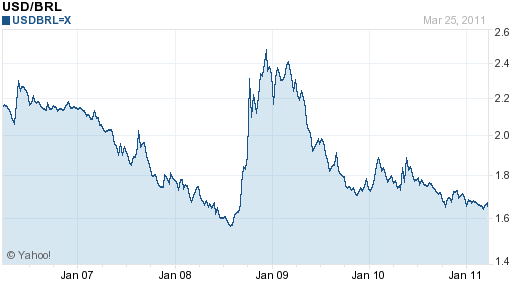
Over the last two years, the Brazilian Real has appreciated a whopping 37% against the US Dollar, second only to the South African Rand. It hasn’t been this strong since prior to the credit crisis, and it is rapidly closing in on a record high. If only Brazilian policymakers hadn’t made it a high priority to prevent that from happening.


The appreciation of the Real is being driven primarily by high interest rates, which in turn, are being driven by inflation. Brazilian prices are now rising at an annualized pace of 6%, which is well above the Bank of Brazil’s comfort zone. As a result, it has already raised rates several times in this cycle, including a 50 basis point hike at the beginning of this month. Its benchmark Selic rate now stands at a stratospheric 11.75%, which is higher than any other currency in the same tier.


Of course, the Bank of Brazil understands the implications of continuing to hike rates. With inflation as high as it is, however, it doesn’t really have much of a choice. Moreover, investors are betting on additional rate hikes, which means even wider interest rate differentials. When you also factor in a surprising lack of volatility surrounding the Real, it will certainly become an even more popular target currency for yield-hungry carry traders.


The government of Brazil, however, is doing everything in its power to repel this kind of speculation, lest it drive up the Real further and threaten the competitiveness of its export sector. In 2010, it tripled the tax rate on foreign investment in fixed income securities, to 6%. It increase scrutiny on local banks that have sought to borrow abroad. The national government has taken to doing more of its borrowing on the international market, and deposited the proceeds directly into its forex reserves, in order to mitigate the impact on the Real. The government is also contemplating punishing short-term investors by establishing a “lock-up” period for foreign capital.


And yet, Brazil finds itself in a quandary. While its trade balance has remained positive, its current account balance is now entrenched in deficit territory. Just like the US, it remaisn dependent on foreign investors to bridge this gap every month. Perennial budget deficits also mean the government can ill afford to alienate lenders. Finally, the government still wishes to attract legitimate foreign direct investment in infrastructure projects and portfolio investment in the stock market.


If Brazil is successful in limiting speculation – which is difficult, but not impossible given its determination – there is a chance that the Brazilian Real will hold steady. After all, Brazil saves less than it needs to invest, and inflation is high enough that there should be some natural downward pressure on the Real. On the other hand, if volatility remains low and speculators continue to find a way around the new capital controls (tempted by 11.75% short-term deposit rates), it will be difficult for the Central Bank to prevent its rise. It can only sit back, continue to hike rates, and pray that speculators soon lose interest.


Personally, I’m betting that the government of Brazil will achieve some measure of success, at least in the short-term. Of all the emerging-market countries engaged in the currency war, it seems to be the most resolute participant after China. At this point, short of fixing the Real to the Dollar, it has shown that it is willing to do whatever it takes to prevent speculators from winning.


SocialTwist Tell-a-Friend
READ MORE - Brazil Gets “Real” about Intervention

UK Forex Reserve Plan could Harm Pound

Thursday, March 24, 2011

Yesterday, UK Chancellor George Osborne announced that his government was ready to begin rebuilding its foreign exchange reserves. Depending on when, how, (or even if) this program is implemented, it could have serious implications for the Pound.


Forex reserve watchers (myself included) were excited by the updated US Treasury report on foreign holdings of US Treasury securities. As the Dollar is the world’s de-facto reserve currency and the US Treasury securities are the asset of choice, the report is basically a rough sketch of both the Dollar’s global popularity and the interventions of foreign Central Banks. Personally, I thought the biggest shocker was not that China’s Treasury holdings are $300 Billion greater than previously believed (with $3 Trillion in reserves, that’s really just a rounding error), but rather that the UK’s holdings declined by 50% in 2010, to a mere $260 Billion.


Given that the Bank of England (BoE) injected more than $500 Billion into the UK money supply in 2010, I suppose that shouldn’t have been much of a revelation. After all, selling US Treasury Securities and using the proceeds to buy British Gilts (sovereign debt) and other financial instruments would enable the BoE to achieve its objective without having to resort to wholesale money printing. In addition, if not for this sleight of hand, UK inflation would probably be even higher.


Still, this is little more than a mere accounting trick, and those funds will probably still need to be withdrawn from the money supply at some point anyway. Whether the BoE burns the proceeds or reinvests them back into foreign instruments is certainly worth pondering, but insofar as it won’t impact inflation, it is a matter of economic policy, and not monetary policy.


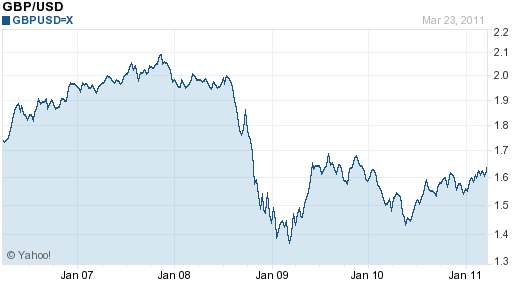
As Chancellor Osborn indicated, the UK will probably send these funds back abroad. In addition to providing support for the Dollar (as well as another reason not to be nervous about the upcoming end of the Fed’s QE2), this would seriously weaken the Pound, at a time  that it is already near a 30-year low on a trade-weighted basis. After falling off a cliff in 2009, the Pound recovered against the Dollar in 2010, largely due to the BoE’s shuffling of its foreign exchange reserves. To undo this would certainly risk sending the Pound back towards these depths.


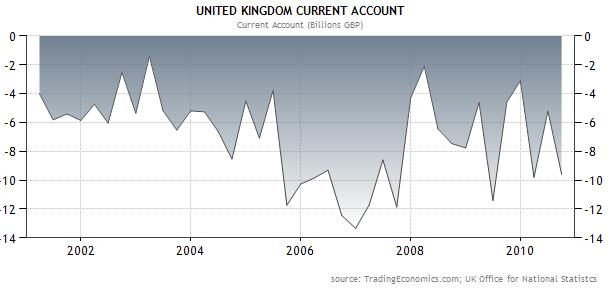
On the one hand, the UK is certainly conscious of this and would act accordingly, perhaps even delaying any foreign exchange reserve accumulation until the Pound strengthens. On the other hand, the BoE is under pressure to fight inflation. It is reluctant to raise interest rates because of the impact it would have on the fragile economic recovery. The same can be said for unwinding its asset purchases. However, if it offset this with purchases of US Treasury securities and other foreign currency assets, it could weaken the Pound and maintain some form of economic stimulus. Especially since the UK has run a sizable trade/current account deficit for as long as anyone can remember, the BoE has both the flexibility/justification it needs to coax the exchange rate down a little bit.


Ultimately, we’ll need more information before we can determine how this will impact the Pound. Still, this is an indication that the GBP/USD might not have much more room to appreciate.


SocialTwist Tell-a-Friend
READ MORE - UK Forex Reserve Plan could Harm Pound

Pound Vs. Euro: Tie Game for Now?

While I’m fondest of analyzing all currencies relative to the Dollar (after all, it’s what I’m most familiar with and is involved in almost half of all forex trades), sometimes its interesting to look at cross rates.


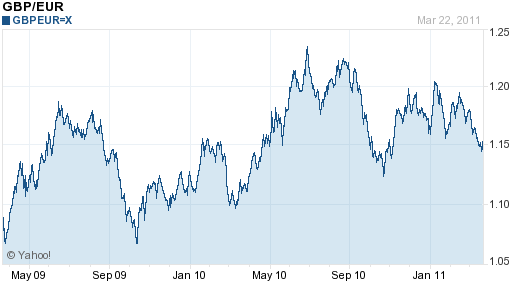
Take the Pound/Euro, for example, arguably one of the most important crosses, and one of a handful that often moves independently of the Dollar. If you chart the performance of this pair over the last two years, however, you can see the distinct lack of volatility. It has fluctuated around an axis of 1.15 GBP/EUR, never straying more than 5% in either direction. In fact, it’s sitting right at this level as I compose this post.


Yesterday, I read some commentary by Boris Schlossberg (whom I interviewed in 2010), Director of Currency Research at GFT. In the title (“Euro and Pound Go Their Separate Ways”), he seemed to suggest that a big move was imminent. Aside from noting that both currencies stand at crossroads, he declined to offer more concrete guidance on the direction of the potential breakout.


At the moment, the markets are gripped by risk aversion, caused by the Mid East political turmoil and the Japanese natural disasters. Once these events run their course and the accompanying market tension subsides, investors will need something else to latch on to. Perhaps the Bank of England (BoE) and European Central Bank (ECB) can fulfill this function, since both are on the verge of hiking their respective benchmark interest rates . Absent any other developments, the timing and speed of such hikes will probably dictate not only how these currencies perform against each other, but also how they perform against the Dollar.


Despite the numerous indications that both have given to the contrary, I don’t think either Central Bank is in a hurry to raise interest rates. Economic growth remains poor, unemployment is high, and inflation is still moderate. Neither is yet at the stage where it can unwind the monetary easing that it put in place at the height of the financial crisis. Moreover, both are wary about the potential impact of rate hikes on their respective currencies (a concern that I am ironically fomenting with this post).


It looks like the BoE will be the first to act. Combined with high energy prices, the bank’s easy monetary policy is putting extraordinary pressure on prices, and it now appears that inflation could reach 5% in 2011. In addition, the BoE voted 6-3 at its last meeting in favor of tightening, which means that a hike probably isn’t too far off. On the other hand, the ECB is talking tough, but it still doesn’t have much of an impetus to act. Inflation is moderate, and besides, the region’s banks remain too dependent on ECB cash for it to serious contemplate being aggressive.


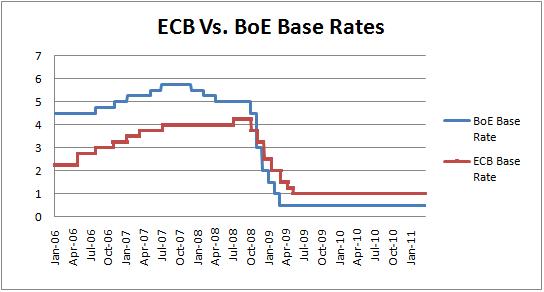
Either way, the interest rate differential probably won’t be great enough to encourage any short-term speculation between the two currencies. In addition, I think investors will continue to look to the Yen and the Dollar for guidance, and we won’t see any significant movement in either direction. [The chart below is based on benchmark lending rates and isn't necessarily applicable for retail forex trading].


This would create two opportunities for investors: Options traders should consider a long straddle, which involves selling a put and call at the same strike price (perhaps 1.15), pocketing the premiums, and praying that the rate doesn’t fluctuate much (since they would be exposed to unlimited risk). In the future, carry traders can also profit from the lack of volatility through a carry trading strategy, perhaps amplified by a little leverage. Be careful, however. Since interest rate differentials are currently so small (The current LIBOR rate disparity is a mere .05%!) and probably won’t widen to more than 1% over the next twelve months, any profits from interest could easily be wiped out by even the smallest adverse exchange rate movements.


SocialTwist Tell-a-Friend
READ MORE - Pound Vs. Euro: Tie Game for Now?

“Currency Manipulation” Will Continue, Despite G20

Tuesday, March 22, 2011

Last month, the G20 finally agreed on the specific factors that would be used to determine whether a country was manipulating its currency. Despite being watered-down (by the usual suspects), the so-called “scorecard” is nonetheless extremely substantive. Unfortunately, the resolution will be backed only by “peer pressure,” rather than any kind of real enforcement mechanism, which means that in practice it is basically worthless.


While the proximate goal of the resolution is to eliminate exchange rate manipulation, it’s ultimate goal is to minimize the risk of another economic/financial crisis. Towards that end, a country’s “budget deficit levels, the external imbalance and private savings rates” will be closely scrutinized, and will be warned if any of these factors reach levels that are deemed to be unsustainable. The idea is that an early warning system will prevent the global economy from reaching a point of disequilibrium that is so severe that crisis would be impossible to avert.


Of course, the problems with this program are manifold. First of all, there are no concrete numbers. For example, it’s not clear how large a country’s national debt or trade deficit has to reach before it receives a phone call and slap on the wrist from the G20. In fact, you could argue that the same imbalances that precipitated the crisis are largely still in place, which means that some countries should have been warned yesterday.


Second, there is no meaningful enforcement mechanism. That means that countries that disregard the resolution don’t really have anything to fear, other than the wrath of investors. In other words, if governments and Central Banks know that they can manipulate their exchange rates with impunity, what’s to stop them? Look at Japan: its public debt is the highest in the world. It runs a perennial trade surplus. Its citizens are notorious savers. And yet, when the Yen rose to a record high, which you might expect from such an imbalanced economy, the G7 (in this case) took the unusual step of pushing the Yen down. I’m not saying this wasn’t the right thing to do, but what kind of signal does this send to other rule breakers.


While all emerging market countries took an active interest in exchange rates (and seek to exert some control over their currencies), China is certainly Public Enemy #1, and is the clear target of the “currency manipulation” talk. To its credit, the People’s Bank of China (PBOC) has permitted the Chinese Yuan to appreciate 20% against the Dollar (probably 30% when inflation is taken into account) over the last few years. Meanwhile, both internal government statisticians and the IMF expect its current account surplus to narrow to a mere 5% in 2011, as its economy slowly rebalances.


In this sense, I think China is a case in point that the best enforcement mechanism is reality. Specifically, China has reached a point where it cannot continue to pursue an economic policy based on exports, without spurring inflation and causing the inefficient allocation of domestic capital (such as in real estate). It must raise interest rates and accept the continued appreciation of the RMB is an unavoidable byproduct.


The same goes for other countries that attempt to hold their currencies down. If they can get away with it, then so be it. If not, I can guarantee that it won’t be the G20 that forces them to change.

SocialTwist Tell-a-Friend
READ MORE - “Currency Manipulation” Will Continue, Despite G20

Does Japan’s “Triple Disaster” Threaten the Dollar?

Monday, March 21, 2011

While analysts have been busy dissecting the implications of the natural disasters that ravage(d) Japan for forex markets, the focus has naturally been directed towards the Yen. Given all the rumors about the liquidation of foreign (i.e. Dollar-denominated) assets, it’s also worth examining the potential impact on the Dollar. In a nutshell, Japan’s holdings of US Treasury Securities are extensive, and even a partial unloading could have serious implications for the world’s de facto reserve currency.


As I explained in my previous post, the Yen rose to a record high (against the Dollar) following the earthquake/tsunami/nuclear crisis because of rumors that Japanese insurance companies and other financial institutions would begin repatriating all of their foreign assets in order to pay for rebuilding. (For the record, it’s worth pointing out again that this has yet to take place, and any repatriation is probably related to the approaching fiscal-year end. Thus, the Yen is being propelled by speculation/short squeeze. Period.)


Indeed, Goldman  Sachs has estimated that the rebuilding effort will probably cost around $200 Billion. A significant portion of this will no doubt be covered by the payout of insurance claims. How insurance companies will make their claims is of course, unknown. However, consider that Japanese insurance companies have insisted that they have ample cash reserves. In addition, Japan has what is perhaps the world’s most solid earthquake reinsurance (basically insurance for insurers) program, which means primary insurance companies can basically pass these claims up the chain, perhaps all the way to the government.


As for whether the Bank of Japan will sell some its $900 Billion in Treasury holdings, this, too appears unlikely. First of all, the Bank of Japan is doing everything in its power to soften the upward pressure on the Yen, which would not be consistent with selling any of its Dollar-assets. Second,  the Financial Times has further argued that they will be especially unlikely to sell US Treasury securities, because they would lose money on (US Dollar) currency depreciation. Besides, any assets that are sold now to pay for rebuilding would probably need to be repurchased later in order to restore balance sheet equilibrium.


While I am on the topic, I want to draw attention to a recent Treasury report that documented the overseas holdings of Treasury securities. The major surprise was China, whose holdings were revised upwards to $1.18 Trillion (from $892 Billion), which means it is well-entrenched as the most important creditor to the US. However, this was offset by a 50% drop in the Bank of England’s holdings, caused perhaps by a change from US debt to British debt.


As I have written in the past, it seems unlikely – for political, economic, and financial – reasons that China will move to pare its Treasury holdings in a significant way. Simply, it has no other viable options for investing the foreign exchange reserves that it is forced to accumulate because of the Yuan-Dollar peg. Other doomsdays have speculated that the crisis in the Middle East will end the “petro-Dollar” phenomenon, whereby oil exporters settle their bills almost exclusively in Dollars and use the proceeds to buy Treasuries. While US influence in the Mid East may indeed wane further as a result of the ongoing political turmoil, I don’t think this will force a change to the PetroDollar phenomenon, which is due as much to unavoidable trade surpluses as it is to settling oil transactions in US Dollars.


There is certainly some concern about what will happen when the Fed wraps up QE2 later this year and stops buying Trreasury securities. Two prominent investment companies (PIMCO and Vanguard) have warned that this will cause bond prices to fall and interest rates on debt to rise rapidly. While this is certainly possible, demand for Treasuries will remain strong for as long as the current risk-averse climate remains in place. In addition, given that the US Treasury is not in danger of defaulting anytime soon, yields reflect expectations for inflation and interest rates more than supply/demand for the bonds themselves. Finally, when the Fed stopped buying mortgage backed securities in 2010, mortgage rates fell, contrary to expectations.


In short, the Dollar might continue to fall against the Yen as speculators cover their short positions, but not because of any fundamental reasons. On an aggregate basis, the never-ending string of crises won’t cause the Dollar to collapse. If anything, it might even bring some risk-averse capital back to the US and re-affirm the Dollar’s status as global reserve currency.


SocialTwist Tell-a-Friend
READ MORE - Does Japan’s “Triple Disaster” Threaten the Dollar?

Explore the world with updated apps for iPhone: Check in with Latitude and use Places in 30 languages

We’re happy to announce updates for two iPhone apps that help you connect the people you care about with the places you love: Google Latitude with check-ins and Google Places in 30 languages.

Check in with Google Latitude for iPhone
After adding check-ins to Google Latitude for Android-powered devices, we’re happy to announce that you can now start checking in at places with the updated Latitude app for iPhone.

With Google Latitude, you can see where your Latitude friends are on a map and choose to continuously share where you are. Now, you can also choose to check in at specific places, such as your favorite restaurant or a park, to add more context to your location. You'll be able to not only let friends know that you’re just around the corner but also let them know the actual coffee shop that you’re at in case they want to join you. If Latitude is set to continuously update your location, you’ll also be automatically checked out when you leave. This way, friends aren’t left guessing if you’re still there or not before heading over to join you for a latte.


Tap the “Check in” button to start checking in at nearby places. Keep checking in every time you visit your favorite places to start gaining special status there. You’ll not only progress to become a Regular, VIP, and then Guru at your favorite places, but if you’re near Austin, Texas, gaining status lets you unlock check-in offers at over 60 places.

Just like with sharing your location, you can control your Latitude check-in privacy. Checking in is 100% opt-in, and you can choose to share any check-in with your friends on Latitude, publicly on the web and your Google profile, or just yourself.

To start checking in with Latitude on your iPhone, update the Latitude app from the App Store. The app requires iOS 4 and above, and it's available for iPhone 3GS, iPhone 4, iPad, and iPod touch (3rd/4th generation). However, background location updating is only available on the iPhone 3GS, iPhone 4, and iPad 3G.

Google Places in 30 languages
Best ever! Me gusta! Mi piace! Ich liebe es! Wherever you are and whatever language you speak, we want to give you the best personalized place recommendations when you use Google Places with Hotpot. Update the Google Places app from the App Store to rate on the go and get personalized recommendations for places in 30 languages.


You’ll also have one more way to personalize your experience: saved places. Sign in with your Google Account using the info icon in the top left corner. Then, tap the new “Saved” icon on the app’s main screen to see all the places that you’ve saved or starred from the app, google.com/hotpot or maps.google.com.

Updates will appear in the App Store in supported countries throughout today. Get the latest version of Google Places from the App Store and start discovering great new places wherever you are!

READ MORE - Explore the world with updated apps for iPhone: Check in with Latitude and use Places in 30 languages

Introducing Nexus S 4G for Sprint

Recently, we introduced Nexus S from Google, the first phone to run Android 2.3, Gingerbread. In addition to the UMTS-capable Nexus S, today we’re introducing Nexus S 4G from Google, available for Sprint. Nexus S 4G is part of the Nexus line of devices which provide a pure Google experience and run the latest and greatest Android releases and Google mobile apps.

We co-developed Nexus S 4G with Samsung to tightly integrate hardware and software and highlight the advancements of Gingerbread. Nexus S 4G takes advantage of Sprint’s high-speed 4G data network. It features a 4” Contour Display designed to fit comfortably in the palm of your hand and along the side of your face. It also features a 1GHz Hummingbird processor, front and rear facing cameras, 16GB of internal memory, and NFC (near field communication) hardware that lets you read information from everyday objects that have NFC tags.

In addition, today we’re excited to announce that Sprint customers will soon be able to take advantage of the full set of Google Voice features without changing or porting their number.

You can find more Nexus S information and videos at google.com/nexus or follow @googlenexus on Twitter for the latest updates. Nexus S 4G can be purchased this spring online and in-store from Sprint retailers and Best Buy and Best Buy Mobile stores in the U.S.


Posted by Andy Rubin, VP of Engineering
READ MORE - Introducing Nexus S 4G for Sprint

Google Search app for iPhone—a new name and a new look

Tuesday, March 15, 2011

If you need to do a Google search on your iPhone or iPod touch it's now faster and easier when you use our redesigned Google Search app, formerly Google Mobile App. If you've been using Google Mobile App for a while, you'll notice that things look different.

The redesigned home screen of Google Search app.


First, you’ll see that there are now more ways to interact with the app. When browsing through search results or looking at a webpage, you can swipe down to see the search bar or change your settings. For those who use other Google apps, there’s an Apps button at the bottom of the screen for rapid access to the mobile versions of our products.

We also included a new toolbar that will make it easier for you to filter your results. You can open this toolbar by swiping from left to right — either before you search or once you’ve got your results. If you only want images, just tap “Images,” and the results will update as shown:


The toolbar helps you to get to the right kind of results.

Second, we’ve made it easier to pick up searching where you left off. If you leave the app and come back later, you’ll be able either to start a new search right away (just tap in the search box to type, hit the microphone button to do a voice search or tap on the camera icon to use Google Goggles) or get back to exactly where you were by tapping on the lower part of the page.

Finally, there are a number of improvements we’ve made to everything else you love in the app, including Google Goggles, Voice Search, Search with My Location, Gmail unread counts and more. There's a lot in the app, so we've added a simple help feature to let you explore it. Access this by tapping the question mark above the Google logo.

The help screen can be accessed from anywhere in Google Search app.


Download and try Google Search app today; it’s available free from the iTunes App Store. You can also scan the QR code below.


READ MORE - Google Search app for iPhone—a new name and a new look

Click-to-call emergency information

Wednesday, March 9, 2011

(Cross-posted from the Google.org blog)

In November 2010, we began displaying relevant emergency phone numbers at the top of the results page for searches around poison control, suicide and other common emergencies in 14 countries. Today, we are making it even easier for you to quickly reach the help you may need by adding click-to-call capabilities for all of these emergency information search results.

We piggybacked on the way that our mobile ads team enabled click-to-call phone numbers in local ads on mobile devices. This capability enables businesses to make it even easier for customers to reach them when those customers search on Internet-enabled mobile devices. The functionality seemed ideal for the emergency information feature.

Previously, mobile users in one of these countries who conducted searches around poison control, suicide and common emergency numbers received a result showing the relevant emergency phone number.

People on mobile will now get the same result, but the phone number will be a link that allows you to dial the number instantly, just by clicking the link.


Now, the poison control result in Spain is click-to-call on a mobile phone

We hope this addition is a small step that helps connect people with crucial information that they need immediately.

READ MORE - Click-to-call emergency information

Instant Previews now available on mobile

Tuesday, March 8, 2011

(Cross-posted from the Official Google Blog)

Instant Previews provides a fast and interactive way to evaluate search results. Starting today, Google Instant Previews is available on mobile for Android (2.2+) and iOS (4.0+) devices across 38 languages. Similar to the desktop version of Instant Previews, you can visually compare search results from webpage snapshots, making it easier to choose the right result faster, especially when you have an idea of the content you’d like to see.

For example, if you’re looking for a webpage that has both photos and descriptions, you can use Instant Previews to quickly identify these pages by navigating across the visual search results with a few swipes of your finger. Or perhaps you’re looking for an article, a step-by-step instructions list, or a product comparison chart—with Instant Previews, you can easily spot pages with the right content without having to navigate back and forth between websites and search results. And when the mobile version of a website is available, we’ll show you a preview of the mobile page.


To use Instant Previews on your mobile device, do a search on www.google.com and tap on the magnifying glass next to any search result. A side-by-side comparison view of the webpage previews for the first page of search results will appear. When you find a result you like, tap on the preview to go straight to the website. It’s as easy as finding a recipe for poaching an egg:


You can learn more about Instant Previews for mobile in our Help Center. We hope that you enjoy finding the right result faster with Instant Previews!

READ MORE - Instant Previews now available on mobile

You’ve got better things to do than wait in traffic

Monday, March 7, 2011

Ever been stuck in traffic, only to find out you’d have been better off going a bit out of your way to take a less congested route? If you’re like me, you probably hear the traffic report telling you what you already know: traffic is bad on the road you’re currently on, and you should have taken another. It doesn’t need to be this way, and we want to help. So we’re happy to announce that Google Maps Navigation (Beta) will now automatically route you around traffic. With more than 35 million miles driven by Navigation users every day, this should add up to quite a bit of time saved!

On a recent trip to New York, I was running late to meet some friends at the Queens Museum of Art. I had no idea that there was a traffic jam along the route I would normally have taken. Thankfully, Navigation routed me around traffic. I didn’t even have to know that there was a traffic jam on I-495, and I got to enjoy a much faster trip on I-278 instead.

Navigation now uses real-time traffic conditions to automatically route you around traffic.

You don’t have to do anything to be routed around traffic; just start Navigation like you normally would, either from the Navigation app or from within Google Maps. Before today, Navigation would choose whichever route was fastest, without taking current traffic conditions into account. It would also generate additional alternate directions, such as the shortest route or one that uses highways instead of side roads. Starting today, our routing algorithms will also apply our knowledge of current and historical traffic to select the fastest route from those alternates. That means that Navigation will automatically guide you along the best route given the current traffic conditions.

Not only can you save time and fuel, you’re making traffic better for everyone else by avoiding traffic jams. Keep in mind that we can’t guarantee that Navigation will be able to find a faster way, but it will always try to get you where you’re going as fast as possible.

You can begin routing around traffic with Google Maps Navigation for Android in North America and Europe where both Navigation and real-time traffic data are available.

Enjoy your newly found free time!

READ MORE - You’ve got better things to do than wait in traffic

An Update on Android Market Security

Saturday, March 5, 2011

On Tuesday evening, the Android team was made aware of a number of malicious applications published to Android Market. Within minutes of becoming aware, we identified and removed the malicious applications. The applications took advantage of known vulnerabilities which don’t affect Android versions 2.2.2 or higher. For affected devices, we believe that the only information the attacker(s) were able to gather was device-specific (IMEI/IMSI, unique codes which are used to identify mobile devices, and the version of Android running on your device). But given the nature of the exploits, the attacker(s) could access other data, which is why we’ve taken a number of steps to protect those who downloaded a malicious application:

  1. We removed the malicious applications from Android Market, suspended the associated developer accounts, and contacted law enforcement about the attack.
  2. We are remotely removing the malicious applications from affected devices. This remote application removal feature is one of many security controls the Android team can use to help protect users from malicious applications.
  3. We are pushing an Android Market security update to all affected devices that undoes the exploits to prevent the attacker(s) from accessing any more information from affected devices. If your device has been affected, you will receive an email from android-market-support@google.com over the next 72 hours. You will also receive a notification on your device that “Android Market Security Tool March 2011” has been installed. You may also receive notification(s) on your device that an application has been removed. You are not required to take any action from there; the update will automatically undo the exploit. Within 24 hours of the exploit being undone, you will receive a second email.
  4. We are adding a number of measures to help prevent additional malicious applications using similar exploits from being distributed through Android Market and are working with our partners to provide the fix for the underlying security issues.

For more details, please visit the Android Market Help Center. We always encourage you to check the list of permissions when installing an application from Android Market. Security is a priority for the Android team, and we’re committed to building new safeguards to help prevent these kinds of attacks from happening in the future.


Rich Cannings, Android Security Lead

READ MORE - An Update on Android Market Security

Tweet your Hotpot ratings in Google Maps for Android

Thursday, March 3, 2011

(Cross-posted on the Hotpot Blog and the LatLong Blog.)


Whether it’s Google Places with Hotpot or Google Latitude, we’re working on helping you connect the people you care about with places you love. Now, when you’re rating your dinner spot using Google Maps for Android, you can share your review with even more people by posting it to Twitter.


Post your ratings and reviews to Twitter
When you rate and review places like restaurants or cafes from Google Places, you can share valuable recommendations with your Hotpot friends and across Google’s products – in search results, on google.com/hotpot, and on Place pages. But we wanted you to be able to share your recommendations even more broadly. So today, you can start sharing your ratings and reviews with your followers on Twitter directly from your Android-powered device.


When rating on the go using our rating widget, just choose to Post review to Twitter and connect your Twitter account. You’ll get a preview of your tweet and will be able to post your ratings and reviews moving forward.


Post your ratings and reviews to your Twitter followers.


Check-ins: ping friends and search for places

Starting last month, you could share information about the place you were at, in addition to your location, by checking in at places using Google Latitude. Starting today, if you see nearby Latitude friends on the map and want to ask them where they are, you can quickly “ping” them instead of having to text or call. They’ll receive an Android notification from you asking them to check in at a place. And when they check in using your request, you’ll get a notification right back so you know which place to go to meet up with them.


From a friend’s Latitude profile, ping them (left) and they’ll receive a notification (right).


You’ll also be able to more easily check yourself in at the right place. Sometimes there are a lot of nearby places around you, and the right one is missing from the suggested list of places to check in. You can now quickly search for the right place using the Search more places button.


Search for the right place to check in if it’s not among the suggested places.


To start posting Hotpot ratings to Twitter and pinging Latitude friends, just download Google Maps 5.2 from Android Market here (on Android OS 1.6+ devices) everywhere it’s already available. Please keep in mind that both Latitude friends need version 5.2 in order to use the new “ping” feature. Learn more in the Help Center.

READ MORE - Tweet your Hotpot ratings in Google Maps for Android

Mobile editing in Google Docs now in 45 languages

Wednesday, March 2, 2011

Last November, we launched the ability to edit mobile docs in English. Today we’re excited to announce that you can now edit your docs on the go in 44 more languages.


To begin editing, visit docs.google.com in your mobile browser, and select a document to edit. Switch from view to edit mode by pressing ‘Edit’ to turn on the mobile editor and start typing away. As a reminder, mobile editing is available on Android (2.2+) and iOS (version 3.0+) devices. You can learn more about Google Docs for mobile on www.google.com/mobile. As always, feedback in the comments and on the forums is appreciated.


READ MORE - Mobile editing in Google Docs now in 45 languages

Honeycomb Buzzes On In

Tuesday, March 1, 2011

Yesterday morning, a tasty treat arrived on our campus. And what better way to welcome Honeycomb to the Android family than with redecorating the lawn of Building 44 a bit?


Posted by Andy Rubin, VP of Android Engineering
READ MORE - Honeycomb Buzzes On In

Deepest condolences for our Khmer fallen heroes

Tuesday, February 8, 2011

Deepest condolences for our Khmer fallen heroes who scarified their lives for defending our sovereignty against the thievery of the Thais at Preah Vihear Temple.
READ MORE - Deepest condolences for our Khmer fallen heroes

"Min You Min Chhabb" a Poem in Khmer by Sék Serei

Thursday, February 3, 2011

I love this poem ! Well said and well read here in Phnom Penh. Thank you Lok Pu Sek Serey !
READ MORE - "Min You Min Chhabb" a Poem in Khmer by Sék Serei

Political cartoon I like

Tuesday, January 11, 2011

I found this cartoon from the net. It's is done by Sacrava. Thank you Lok Pou Sacrava your picture is worth thousand of words ! So true. Freedom of expression is at best. Vannak -- Phnom Penh
READ MORE - Political cartoon I like

Publications that enhance our Khmer democracy and leadership

Thursday, February 12, 2009


Last year after I read "Khmer Leadership Part 1" I had to wait more than 6 months before the Part 2 was available. Now both parts are widely circulated on the internet. I now just finish reading it. These two books are so good. A lot of ideas and accountability of leaderships should be. Not the kind of leaders as Global Witness has recently published in Country For Sale: Welcome to Cambodia


These publications are among those kind our Khmer government would love to burn because the guilty conscience of our current leaders cannot stand the truth. And that's why they want to completely discredit the truth or destroy it.


ពីខ្ញុំ, វណ្ណះ
ភ្នំពេញ
READ MORE - Publications that enhance our Khmer democracy and leadership

Cambodian numerals on Thai currency

Saturday, January 31, 2009


"Khmer numerals have been written on every Thai bank note and on every Thai coin along with the picture of the Thai King to prove that Khmer are the Master of Thai always."

Above was the comment left on my blog.

Vanak-Phnom Penh
READ MORE - Cambodian numerals on Thai currency

My view on Lèse majesté law in Thailand

Sunday, January 11, 2009

Website Sacrava by Khmer political cartoonist in Australia was blocked in Thailand for violating Lèse majesté law.

I thought about Lèse majesté law in Thailand. It is the law for individual not to do anything to insult Thai king Bhumibol Aduljadej. Don't critise him. Dont's say bad stuffs about him. Don't draw satire cartoon of him. Don't spray paint over his picture. The offender who violates Lèse majesté will be tossed in jail from 3 to 15 years. So remember one thing, when in Thailand do like the Thais do: "Don't ever insult Bhumibol Aduljadej."

I respect Bhumibol no more and no less than any fellow human being. To me, Bhumibol Aduljadej is no God. My reasons are just simply that Bhumibol eats, drinks, goes to the toilet and furthermore Bhumibol's excrement stinks just like mine and everyone else.

Regarding Lèse majesté, although I think it's archaic and outdated law in this day and age, but nevertheless, it's still Thai's law. If I ever set my foot on Thai soil I would respect their laws. The same if I'm to visit any other country, I would respect the local laws of that country.

Here I am in Cambodia I want to exercise my freedom of speech. Thailand has no right to apply their Lèse majesté upon me.

Thanks goodness. I'm in my beloved country!

Vanak,
Phnom Penh.
READ MORE - My view on Lèse majesté law in Thailand